Back to Top

Tag Archives: apostasy

Jude: Creeps in the Church

  Following is an excerpt (the Preface) of the upcoming book, Jude: Creeps in the Church.  This book is part of the new Study Guide Series by author, Jeff Kluttz.  This series is verse-by-verse expositional outlines of entire biblical books.  These works are suitable for personal study, pastoral commentary and outline study, or in use for a teacher preparing to teach a biblical book.  Jude is the first.  Romans Vol. 1 is written, and 2/3rds re-written.  Afterward it will be edited and released, probably mid-June.  Romans Vol 2, Malachi, and Jonah are also written and are still subject to re-writes and editing.  (Malachi/Jonah will come in a single volume)

You can find all books at Jeff Kluttz’ author page, here: https://www.amazon.com/author/kluttz

*************************************

The Preface to Jude: Creeps in the Church

Preface


Jude sat down to write one letter and was compelled by circumstance to write another. He had intended a celebration — a word of encouragement about the salvation his readers shared with him and with one another. Instead, he found it necessary, by his own description, to write a letter of alarm. Impostors had crept into the congregations. The false teachers that Peter had prophesied were no longer a coming threat. They had arrived. The letter he wrote in response to that reality is twenty-five verses long and runs with the sustained urgency of a man who cannot afford to be misunderstood.

That urgency has not diminished with the passing of two thousand years. The men Jude described — self-guided, self-serving, self-promoting, defiling their own flesh while teaching others to do the same, denying the lordship of Christ while using his name as their credential — are not a first-century curiosity. They are a permanent feature of the church age. Jesus said so in the Olivet Discourse. Paul said so in his letters to Timothy. Peter said so in the letter Jude quotes throughout his own. The apostolic witness on this subject is unanimous: the church age will be characterized by this kind of corruption, and it will grow worse as the age advances toward its end. Jude’s letter is not a historical artifact. It is a living document addressed to every generation of the church that has ears to hear it.

This commentary and teaching guide exists because of a problem that every serious teacher of God’s word eventually faces. The resources for studying a biblical text are rich and vast — commentaries, lexicons, word study tools, historical backgrounds, canonical cross-references, the accumulated scholarship of centuries. Engaging them thoroughly is rewarding. It is also time-consuming, technically demanding, and productive of far more material than any single lesson, sermon, or study can contain. The typical result of a thorough study of a biblical passage is that eighty percent of what has been discovered never makes it into the room where the teaching actually happens. It ends up on the cutting room floor — not because it was unimportant, but because the work of distillation is itself an enormous task, and the teacher who has already spent hours in the research rarely has equivalent hours remaining for the refinement.

This work is designed to represent the useful twenty percent — already distilled, already organized, already in a form that can be taken directly into the teaching context without further processing. Every chapter follows the text of Jude verse by verse. Original Greek terms are examined where they carry the weight of the argument, with their meanings unpacked in plain language and their significance to the passage made explicit. Historical and canonical context is provided where it is essential to understanding what Jude is saying and why. Old Testament backgrounds are traced where Jude draws upon them. The argument of the letter is followed from its opening alarm to its closing doxology as a coherent whole, with each chapter building on what has come before and anticipating what follows. No prior knowledge of Greek is required. No supplementary tools are necessary. The work has already been done.

A word about the approach to scripture that governs this work. Every conclusion reached in these pages is formed by a careful examination of the biblical text itself. The author is a Biblicist — one who believes that the Bible is the literal word of God, that all essential doctrines of the Christian faith are discovered and defined by the writings it contains, and that all biblical teaching is to proceed from one’s understanding of scripture rather than from any political, ideological, or cultural framework external to it. Where the author offers a personal opinion on a disputed matter — as he does, for instance, in the discussion of Genesis 6 and the identity of the sons of God — he says so plainly and invites the reader to examine the evidence and arrive at his own conclusion. The goal throughout is not to impose a reading but to open the text.

Scripture quotations in this work are taken primarily from the Christian Standard Bible. Primary teaching texts — those passages that are the direct subject of the chapter’s exposition — are presented as indented block quotations. Supporting and corollary scriptures that illuminate the argument without being its primary focus are embedded in the prose with their references noted inline. Original language terms are italicized throughout.

What follows is a chapter-by-chapter journey through one of the most urgent letters in the New Testament canon. The journey begins where Jude begins — with the question of who he was, who he was writing to, and what had compelled him to write at all. It ends where Jude ends — with his eyes lifted from the impostors in the room to the God who is able to protect his people from stumbling and to present them blameless in his glory with great joy. Between those two points, Jude covers more theological and pastoral ground than the brevity of his letter might suggest. This guide is an attempt to ensure that none of that ground is left uncovered.

Jude called his readers to contend earnestly for the faith once for all delivered to the saints. The faith has not changed. The contention is still required. May this work serve those who have answered that call.

Kindle is online now – you’ll find it here

Paperback coming June 1st – you’ll find it here

(see all books here)


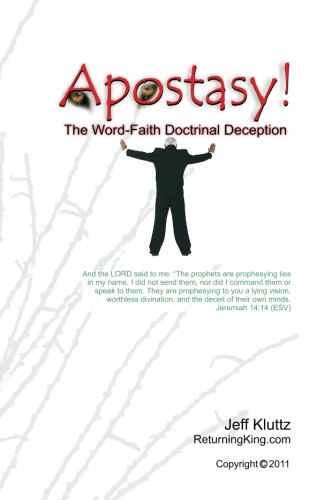
Apostasy! is Released (New Book)

Apostasy! The Word-Faith Doctrinal Deception is released today on Amazon.com in print and Kindle editions.

Apostasy! is the result of several years of research and teaching concerning the doctrinal heritage of the Word of Faith movement. Numerous churches are finding themselves dealing with doctrines that have no biblical basis. They are, instead, the product of carefully corroborated and systematized “new” doctrinal distinctions that are aimed at the financial empowerment of the teachers of this movement.
cover
Many believers are hearing such doctrines from their church pulpits without awareness of their sources.
This book seeks to track the origination of these add-on doctrines and to reveal how their acceptance will alter systematic theology. Poor doctrines do not merely stick to the roof where they are preached: they infiltrate every dependent area of theology and create a truly heretical off-shoot of the historic Christian faith.
The Word of Faith, at its full fruition, teaches that God is not the all-powerful creator in his own accord, Jesus did not come to Earth as God incarnate, salvation was purchased in the Lake of Fire rather than on a cross, and that God can be forced to give man anything he commands. Sixteen chapters will reveal these, and many other exceptional errors in the movement’s dogma, each demonstrated by documented and footnoted quotes of the most famous of the Word-Faith teachers.
If you have found yourself scratching your head as to the origins of some of these “new” doctrinal positions, this book will lead you to their sources and the biblical rebuttal.
Available soon at other major retailers, Google books and E-books.
See all books from the author here.

How We Got Here

The following is an excerpt from the author’s upcoming book, Apostasy!  This book will be based largely on the resarch work in the Wolves in Wool series on this blog.


How We Got Here

The gospel message is – and always has been – by Christ, from Christ and for Christ.  At any point this understanding is corrupted, apostasy is sure to follow.  If salvation is not by Christ, then it is by some other means which will ultimately take Christ’s place as the author and sustainer of salvation.  The most obvious example of this is the Roman Catholic Church, which after corrupting its gospel to a sacramental and sacerdotal system of works, became more important than Christ’s own work in the church’s now-corrupt doctrine of salvation.  Continue Reading

The Seven Churches Pt. 3 – Ephesus, pt. A (video)

(This is a confinuation of “The Seven Churches” Vlog series on the churches of Revelation 1-3.  You may also want to watch other videos in this series to keep within context.)

  The first church John was asked to address of the seven was the church in Ephesus; a church which received both praise and rebuke from the Lord’s letter.

This week’s study focuses on the commendation to the church.  The rebuke will be dealt with in next week’s study.

Overwhelmingly, it is clear from the letter to the church at Ephesus that the faith entrusted to the saints is indeed something to be contended for: as the Lord himself gives his commendation to his church for not tolerating evil men and heresy.

The Seven Churches – Ephesus, pt. 1 from Jeff Kluttz on Vimeo.

The Seven Churches – Introduction (Video)

  Today begins a new study series on the Video Blog area of Returningking.com.  This series, currently being preached at First Baptist Church in Needville, TX, is an examination of the Seven Churches which the book of Revelation is written to in Asia Minor. 

The title of the series, however, is not “The Seven Churches of Asia Minor,” but rather “The Seven Churches,” because once one begins interpretational work on the book of Revelation it becomes clear that the seven churches do not only represent the seven historical churches whose names are written on the letter. Rather, these seven churches are seen throughout history, which is the context of the book of Revelation:

Revelation 1:19 (ESV)
19 Write therefore the things that you have seen, those that are and those that are to take place after this.

The Seven Churches (Intro, pt 1) from Jeff Kluttz on Vimeo.

Wolves in Wool Conclusion: From Christ to Antichrist

From Christ to Antichrist


(NOTE:  This is a continuation of the Wolves in Wool Series.  This post assumes the prerequisite reading of earlier posts)

As it has been demonstrated that an apostasy must precede the tribulation, and an utter “anti-gospel” is to be the characteristic of a singular religious system during the great tribulation, it only stands to reason that one may trace the roots of the former apostasy to the latter full-fledged abomination which is spawned from it.  As noted, I cannot positively contend that our current growing apostasy in Christendom is indeed the apostasy which scripture warns will precede the day of the Lord.  Yet, I am compelled to examine such possibilities.


If a man, for example, sincerely believes his life to be in danger by one of his associates, he would surely watch for signs of such growing antagonism toward himself.  He may become quite paranoid, in fact, and pre-occupied with an investigation concerning the possible playing out of his fears.  I do not desire to become paranoid nor to anxiously accuse every false theological principle as a precursor to the coming worship of Antichrist.  Yet, I do wish to heed Jesus’ own warnings concerning our need to be watching for the proper signs of such coming events. Continue Reading

A Coming One-World Religious System

The Coming One-World Religious System

(NOTE:  This is a continuation of the Wolves in Wool Series.  This post assumes the prerequisite reading of earlier posts)

Skipping ahead from the slow-burn apostasy which permeates Christendom today, scripture also clarifies the finality of this degradation of worship and truth.  While scripture specifically notes that apostasy is a characteristic of the latter days, it further demonstrates the fruition of such apostasy; being characterized as a great harlot of world-wide influence.


In Jewish thought, there existed two ages.  “This” age referred to the age before the advent of Messiah’s reign, and “the age to come” referred to the age of Messiah’s reign.  Such thinking is what prompted the disciples to ask Jesus in Matthew 24,

Matthew 24:3 (NIV)
3 … “Tell us,” they said, “when will this happen, and what will be the sign of your coming and of the end of the age?” Continue Reading

A Custom-Built Gospel

A Custom Built Gospel

(NOTE:  This is a continuation of the Wolves in Wool Series.  This post assumes the prerequisite reading of earlier posts)

The last observation concerning this

great falling away is that it is a process which is consumed with the task of changing the gospel message.  After all, what better means could our enemy employ other than to deceive an entire generation into believing a false gospel?  If a false gospel is introduced into the church which can be largely accepted, it serves several important demands of Satan’s own kingdom program.

A false gospel will largely hinder the true gospel’s advance.  Obviously, every church which teaches a corrupt gospel cannot lead its membership to salvation by grace through faith in Christ.  It necessarily will then become a disarmed outpost in this spiritual war.  People will attend services, receive a fast-food “feeding” and feel somewhat enlightened and encouraged, so they may resume their life of sin with a false sense of security. Continue Reading

Today’s Apostasy: Inventing Doctrine

(NOTE:  This is a continuation of the Wolves in Wool Series.  This post assumes the prerequisite reading of earlier posts)

Concerning today’s massive population of false teachers, scripture also offers several texts which warn us of the propensity of these teachers to teach outside of the Word of God.  While these texts do not speak specifically about a latter day apostasy, they do speak volumes concerning the very nature of false teachers; namely, where their doctrines come from and why they are to be avoided. Continue Reading

The Consumerization of the Gospel

(NOTE:  This is a continuation of the Wolves in Wool Series.  This post assumes the prerequisite reading of earlier posts)

The great falling away is further demonstrated in scripture by what can best be understood as a “consumerization” of the gospel.  A further indication of a future apostasy is noted in 2 Timothy.  In this text, Paul does not specify an apostasy which will immediately precede the tribulation, but he does note a later time in which men will refuse sound doctrine.  And, as will be demonstrated, his teaching clearly articulates the very same elements of apostasia as were noted earlier.

2 Timothy 4:3-4 (NIV)
3 For the time will come when men will not put up with sound doctrine. Instead, to suit their own desires, they will gather around them a great number of teachers to say what their itching ears want to hear. 4 They will turn their ears away from the truth and turn aside to myths.

Concerning the mentality during this coming age, Paul makes several assertions.  First, he notes the consumerism of the Word of God.  He states that “men will not put up with sound doctrines,” but will instead choose those which “suit their own desires.”  As if doctrines can be “shopped” for discriminately, these men hear the legitimate truth and simply make a decision not to accept it in light of the error which they prefer.  Such is the nature of consumerism.  If I want a blue car, I do not have to purchase a red one, for blue ones are readily available.  If, likewise, I want to serve a God who lives to please me, I can make such a choice as well, for men are available readily who will preach such a gospel to my ears.  Paul notes, “to suit their own desires” they will accumulate such teachers.  Thus, it is the desires of man himself which will orient doctrines in this coming age.  What man desires to hear as “truth” will be given to him as such.  Welcome to custom-built theology 101.

Noted in the text is that there are “a great number” of teachers who will provide such self-tailored theological services.  As such, it is clear that a great quantity of people will desire to hear such doctrines, and will give validation to the false teachers which propagate them.  It is at this point the reader should take great caution concerning the nature of how religious truth is noted to be validated in our culture.  Simply because the masses affirm it to be true does not make something true.  Clearly the times will come when the masses will align themselves with false teachings over legitimate doctrine.  However, unlike a made-to-order hamburger, which is built for man’s personal demands of consumption, doctrine is by definition something which belongs to its creator. 

We live, however, in a culture of consumerism.  Even our very governmental system is so designed that men get what the ultimately want (at least ideally) by voting for candidates which represent their desires.  This culture has proven to be a fertile ground for the propagation of such false doctrines by the itchy ears of the crowd.  Both the Word of Faith Movement and the Emerging Church movement are beacons of opportunity for those seeking a consumerized gospel.

The Word of Faith has made itself exceptionally proficient at promising the desires of men’s hearts.  Their doctrinal position is precisely crafted to scratch the ears of their willing constituency.  They teach that man can have anything he wants if he learns how to properly utilize the “word of faith.”  How ingenious!  Without the necessities of a litmus test or focus group studies, these men literally promise that men can have their own desires regardless of what they happen to be.  Do you want healing? 

“You may have sickness in your body; you need to call in health.”
“Your circumstances will line up with your words.”
“Joel that sounds like wishful thinking. No, that’s using your words to create what you need.”
“You can change your world by simply changing your words.”
Joel Osteen (“Speaking Faith Filled Words”, Tape # 223, May 2, 2004)

Do you want money? 

“What do you need? Start creating it. Start speaking about it. Start speaking it into being. Speak to your billfold. Say, “You big, thick billfold full of money.” Speak to your checkbook. Say, “You, checkbook, you. You’ve never been so prosperous since I owned you. You’re just jammed full of money.”
Marilyn Hickey (Claim Your Miracles audiotape #186, side 2)

Indeed, whatever man wants to acquire for his own glory, there is a Word of Faith teacher prepared to instruct him (for the price of admission) on how to use “faith words” to receive it.  Rest assured, “Think Your Body Thin” and “Command Yourself to Beauty” are soon to follow, as these men are masters at scratching ears which itch.

In the end, their bogus systematic theology puts man literally in the driver’s seat, being equal with God himself.  After all, if man can “speak” whatever his heart desires into existence, what power or purpose remains for God himself?  Fred Price rightly defines their position as ne notes,

“Yes! You are in control! So, if man has control, who no longer has it? God.”
Fredrick K.C. Price (“Prayer: Do You Know What Prayer Is … and How to Pray?” The Word Study Bible, 1990 p. 1178)

Returning to the original sin of Satan himself, WOFers have indeed recognized and responded to the greatest itch man has ever had; his desire to be his own god.  Their demonic dogma aligns loyal followers with Satan himself as they ascribe to “be like the Most High.”  According to Paul Crouch,

“He [God] doesn’t even draw a distinction between Himself and us. . . . You know what else that’s settled, then, tonight? This hue and cry and controversy that has been spawned by the Devil to try and bring dissension within the body of Christ that we are gods. I am a little god! . . . I have His name. I’m one with Him. I’m in covenant relation. I am a little god! Critics, be gone!”
Paul Crouch (Praise the Lord, TBN? July 7, 1986)  [with Ken Copeland nodding in agreement]

Itch, be scratched.

The nodding Copeland fully affirms this teaching as he notes,

“You don’t have a god in you, you are one”
Kenneth Copeland (The Force of Love, 1987, audiotape #02-0028, side 1)

When I first began investigating the incredulous doctrines of this group, I must admit that I didn’t really get what they were all about.  I just thought Word of Faith preachers were run-of-the-mill tares in the wheat; simple misguided and half-baked theologians who got way too much attention.  I’ve learned that they are much more than that.  They are master deceivers who know what men want to hear.  They are opportunists who gladly will contort God’s eternal Word to suit the greed of their followers, which in turn feeds their own greed through donations and fiction book sales.  They are the systematic fulfillment of scripture; those who men gather around themselves to “say what their itching ears want to hear. 4 They will turn their ears away from the truth and turn aside to myths.”  

Not to be overshadowed, the liberal end of the Emergent pool has perhaps outdone even the creepy doctrines of the WOF.  While the WOF attempts to corrupt God’s word for their own purposes, the Emergent left have devised a system where such creative theological twisting need not even be agreed upon during limousine rides between preaching gigs. Indeed, the “lesson” at the next venue may be completely different, depending upon the local opinions.

By shrugging off systematic theology and embracing a purely narrative approach to scripture, God’s Word is now read as poetry by the Emergent ear scratcher.  It says to you what you want it to say, like your copy of Kubla Khan.  The more radical Emergents have systematically deconstructed scripture, resulting in each individual congregation holding the interpretational “rights” to it through community acquiescence.  They claim that one cannot understand scripture fully, but only through the collective imaginative opinions of the group can its meaning be put into proper practice.  As Rob Bell so eloquently doubts,

This [that the biblical canon was not settled until the 4th century] is part of the problem with continually insisting that one of the absolutes of the Christian faith must be a belief that “Scripture alone” is our guide. It sounds nice, but it is not true. In reaction to abuses by the church, a group of believers during a time called the Reformation claimed that we only need the authority of the Bible. But the problem is that we got the Bible from the church voting on what the Bible even is.
Rob Bell (Velvet Elvis, – Rethinking the Christian Faith, Zondervan: Grand Rapids, 2005, pp. 67-68)

Thus, the church trumps the Bible in its own authority.  Because the Bible was penned and affirmed by men, it can only be rightly interpreted by community pool.  One community reads their Bible and concludes (by general consent) that homosexuality is good and right.  Another reads the same Bible and concludes that homosexuality is wrong.

Frankly, many of us don’t know what we should think about homosexuality. We’ve heard all sides but no position has yet won our confidence so that we can say ‘it seems good to the Holy Spirit and us.’ That alienates us from both the liberals and conservatives whom seem to know exactly what we should think. Perhaps we need a five-year moratorium on making pronouncements. In the meantime, we’ll practice prayerful Christian dialogue, listening respectfully, disagreeing agreeably. When decisions need to be made, they’ll be admittedly provisional. We’ll keep our ears attuned to scholars in biblical studies, theology, ethics, psychology, genetics, sociology, and related fields. Then in five years, if we have clarity, we’ll speak; if not, we’ll set another five years for ongoing reflection.
Brian McLaren (online source:  christianitytoday.com/le/currenttrendscolumns/leadershipweekly/cln60123.html)

With the validity of theology relegated to “what we should think,” men need only find a church which “thinks” their own doctrinal position to be validated by the whole of the Emergent position.  Relativity is not seen as incompatible with scripture.  Truth for me may or may not be truth for you, though it flows from the same fountain.

Scritch, scritch, scritch.

Paul’s wisdom, inspired by the Holy Spirit, should cause all who fear God and respect his word to reconsider the validity of all such foolishness.  He could no more clearly have stated what is obviously at large in today’s open-minded theological soup of the WOF and Emergent movements.  “The time will come when men will not put up with sound doctrine.” 

The term translated for “sound” (doctrine) is the Gk. hygiaino, which literally means “healthy” or figuratively means “uncorrupted.” 

How interesting. 

Being “uncorrupted” is precisely the antithesis of apostasia, as was observed in the last section.  That which is apostate is that which was at one point healthy and uncorrupted, but has now been rendered unhealthy and corrupted.  Furthermore, it is clear that it is indeed such apostasy that he speaks of here in 2 Timothy 4, as he notes in verse 4, “4 They will turn their ears away from the truth and turn aside to myths.”  The ears of those who formerly heard the truth are turned aside.  They know and have heard good theology in the past, but choose to no longer put up with it. 

Thus, what Paul reveals concerning “sound” theology bears the identical definition of what he noted (in the last section) in 2 Thessalonians concerning the coming apostasy of the last days:

2 Thessalonians 2:3 (NIV)
3 Don’t let anyone deceive you in any way, for that day will not come until the rebellion [apostasia] occurs and the man of lawlessness is revealed, the man doomed to destruction.

Those who will not put up with sound doctrine, but instead choose that which scratches their ears are of the very same essence as the apostasia.  In both cases, men who have heard, known and understood valid theology will turn it aside in lieu of what is deemed more desirable for their own consumption.  Paul’s warnings continue to point to an increasing rebellion from the very body of Christ as time progresses.  Particularly, the last days are noted to be a time of such manifestations of false doctrines.  I am not comfortable making presumptions concerning our current state of apostasy in the church.  I’m not going to announce half-cocked that the last days are upon us.  Yet, I can- and must- acknowledge that the modern church is uniquely poised as a candidate for those days prior to the end.  The fat lady may very well be warming up in the greenroom.

Matthew 24:12-14 (NIV)
12 Because of the increase of wickedness, the love of most will grow cold, 13 but he who stands firm to the end will be saved. 14 And this gospel of the kingdom will be preached in the whole world as a testimony to all nations, and then the end will come.