Back to Top

Author Archives: kluttz

Jude: Creeps in the Church

  Following is an excerpt (the Preface) of the upcoming book, Jude: Creeps in the Church.  This book is part of the new Study Guide Series by author, Jeff Kluttz.  This series is verse-by-verse expositional outlines of entire biblical books.  These works are suitable for personal study, pastoral commentary and outline study, or in use for a teacher preparing to teach a biblical book.  Jude is the first.  Romans Vol. 1 is written, and 2/3rds re-written.  Afterward it will be edited and released, probably mid-June.  Romans Vol 2, Malachi, and Jonah are also written and are still subject to re-writes and editing.  (Malachi/Jonah will come in a single volume)

You can find all books at Jeff Kluttz’ author page, here: https://www.amazon.com/author/kluttz

*************************************

The Preface to Jude: Creeps in the Church

Preface


Jude sat down to write one letter and was compelled by circumstance to write another. He had intended a celebration — a word of encouragement about the salvation his readers shared with him and with one another. Instead, he found it necessary, by his own description, to write a letter of alarm. Impostors had crept into the congregations. The false teachers that Peter had prophesied were no longer a coming threat. They had arrived. The letter he wrote in response to that reality is twenty-five verses long and runs with the sustained urgency of a man who cannot afford to be misunderstood.

That urgency has not diminished with the passing of two thousand years. The men Jude described — self-guided, self-serving, self-promoting, defiling their own flesh while teaching others to do the same, denying the lordship of Christ while using his name as their credential — are not a first-century curiosity. They are a permanent feature of the church age. Jesus said so in the Olivet Discourse. Paul said so in his letters to Timothy. Peter said so in the letter Jude quotes throughout his own. The apostolic witness on this subject is unanimous: the church age will be characterized by this kind of corruption, and it will grow worse as the age advances toward its end. Jude’s letter is not a historical artifact. It is a living document addressed to every generation of the church that has ears to hear it.

This commentary and teaching guide exists because of a problem that every serious teacher of God’s word eventually faces. The resources for studying a biblical text are rich and vast — commentaries, lexicons, word study tools, historical backgrounds, canonical cross-references, the accumulated scholarship of centuries. Engaging them thoroughly is rewarding. It is also time-consuming, technically demanding, and productive of far more material than any single lesson, sermon, or study can contain. The typical result of a thorough study of a biblical passage is that eighty percent of what has been discovered never makes it into the room where the teaching actually happens. It ends up on the cutting room floor — not because it was unimportant, but because the work of distillation is itself an enormous task, and the teacher who has already spent hours in the research rarely has equivalent hours remaining for the refinement.

This work is designed to represent the useful twenty percent — already distilled, already organized, already in a form that can be taken directly into the teaching context without further processing. Every chapter follows the text of Jude verse by verse. Original Greek terms are examined where they carry the weight of the argument, with their meanings unpacked in plain language and their significance to the passage made explicit. Historical and canonical context is provided where it is essential to understanding what Jude is saying and why. Old Testament backgrounds are traced where Jude draws upon them. The argument of the letter is followed from its opening alarm to its closing doxology as a coherent whole, with each chapter building on what has come before and anticipating what follows. No prior knowledge of Greek is required. No supplementary tools are necessary. The work has already been done.

A word about the approach to scripture that governs this work. Every conclusion reached in these pages is formed by a careful examination of the biblical text itself. The author is a Biblicist — one who believes that the Bible is the literal word of God, that all essential doctrines of the Christian faith are discovered and defined by the writings it contains, and that all biblical teaching is to proceed from one’s understanding of scripture rather than from any political, ideological, or cultural framework external to it. Where the author offers a personal opinion on a disputed matter — as he does, for instance, in the discussion of Genesis 6 and the identity of the sons of God — he says so plainly and invites the reader to examine the evidence and arrive at his own conclusion. The goal throughout is not to impose a reading but to open the text.

Scripture quotations in this work are taken primarily from the Christian Standard Bible. Primary teaching texts — those passages that are the direct subject of the chapter’s exposition — are presented as indented block quotations. Supporting and corollary scriptures that illuminate the argument without being its primary focus are embedded in the prose with their references noted inline. Original language terms are italicized throughout.

What follows is a chapter-by-chapter journey through one of the most urgent letters in the New Testament canon. The journey begins where Jude begins — with the question of who he was, who he was writing to, and what had compelled him to write at all. It ends where Jude ends — with his eyes lifted from the impostors in the room to the God who is able to protect his people from stumbling and to present them blameless in his glory with great joy. Between those two points, Jude covers more theological and pastoral ground than the brevity of his letter might suggest. This guide is an attempt to ensure that none of that ground is left uncovered.

Jude called his readers to contend earnestly for the faith once for all delivered to the saints. The faith has not changed. The contention is still required. May this work serve those who have answered that call.

Kindle is online now – you’ll find it here

Paperback coming June 1st – you’ll find it here
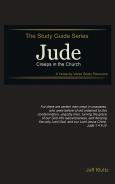
(see all books here)


The Study Guide Series

The new Study Guide Series is being developed as we speak.  Jude: Creeps in the Church has hit the Kindle shelf (a small, easy book to start with!) and will be released in paperback on June 1st at Amazon (Get It Here).  Next in the que is Romans Pt. 1, which is about halfway edited. 

(see all books here)


So what is this all about???

Every serious student of God’s word faces the same challenge. The resources exist — the commentaries, the lexicons, the word study tools, the historical backgrounds — and they are rich beyond measure. But they are also vast, technical, and often designed for the scholar rather than the teacher or student.  Hours of careful research regularly produce far more than any single lesson, sermon, or study can utilize. The discovery is rewarding. The distillation is exhausting. And the question that every pastor, lay teacher, or student eventually asks is the same: where is the resource that has already done this work — and done it well?

The Study Guide Series is a verse-by-verse teaching series designed to answer that question for every book of the Bible it covers. Each volume works through its text with careful attention to the original Hebrew and Greek, the historical and canonical context, the biblical backgrounds, and the flow of the argument from first verse to last — and presents all of it in a form that is immediately usable by anyone studying or called to teach the Word, regardless of their formal training. No prior language knowledge is required. No supplementary tools are necessary. The serious work of scholarship has been done and distilled into the twenty percent of the effort that actually makes it into the room where learning happens.

Whether you are a pastor preparing a sermon series, a small group leader working through a book of the Bible with your congregation, or a student of scripture who wants to go deeper without getting lost, The Study Guide Series gives you what you need — a reliable, thorough, accessible guide to the text in your hands, and the confidence that comes from knowing you have not merely skimmed the surface of what God has said.

(see all books here)

Yom Kippur – The Foreshadowing of Christ

(This is a continuation of the series entitled, “A Pastoral Soteriology.”  It assumes the reading of eariler posts.)

The culmination of the sacrificial system of atonement in the Old Testament Law was demonstrated and applied in the yearly observation of “Yom Kippur,” or, “The Day of Atonement.”  While the sacrificial system tirelessly went about its business of providing blood offerings – literally twenty four hours a day – this special holy day provided the principle application of the sin offering for the entire nation.  As such, Yom Kippur demonstrated more articulately the nature of Christ’s later work of redemption than perhaps any other requirement of the sacrificial system.  Continue Reading

Atonement in the Old Testament Law

Atonement in the Old Testament Law

As noted in the last post, the Penal Substitution Theory of the atonement is by far the best and most accurate understanding of the work Jesus provided on the cross according to the scriptures.  While the nature of the atonement has been observed, a true understanding of penal substitution requires a comprehension of the underlying principles which had been put into effect by God prior to Jesus’ work on the cross.  Continue Reading

The Penal Substitution Theory: On the Mark

The Penal Substitution Theory

While all atonement theories examined thus far have failed at producing a biblically-based portrayal of the doctrine of salvation, Anselm had at least gotten close with his Necessary-Satisfaction Theory.  Building upon some of those very principles, the Penal Substitution Theory, proposed by John Calvin (1509-1564), rightly aligned the missing theological puzzle pieces to present an accurate depiction of the work Christ completed on the cross. 

Primarily, atonement theories are intended to illustrate how atonement was produced from Christ’s death on the cross.  As such, a sound theory must not only make some valid assertions concerning the nature of Christ’s work, but must illustrate the entire historical revelation of the atonement as defined in scripture.  Calvin’s Penal Substitution Theory does that with great skill.

A proper understanding of the Penal Substitution Theory requires a holistic approach to God’s revelation of atonement throughout scripture.  Jesus did not merely show up on the playing field and create something new.  Rather, he realized and fulfilled what God had already established; a substitutionary system of atonement.  As Jesus noted,

Matthew 5:17-18 (NIV)
17 “Do not think that I have come to abolish the Law or the Prophets; I have not come to abolish them but to fulfill them. 18 I tell you the truth, until heaven and earth disappear, not the smallest letter, not the least stroke of a pen, will by any means disappear from the Law until everything is accomplished.

Clearly, Jesus himself understood his work to be complimentary to what had already been established.  His work was to be that which would fulfill the law and the prophets rather something entirely new and unrelated.  No system examined in this series thus far has expressed atonement in terms that related it as a fulfillment of the Law and the prophets.  The Recapitulation Theory disregards the Law almost entirely.  The Ransom Theory has God paying off Satan, which is dramatically opposed to the Old Testament Law in which God himself receives (or rejects) man’s sin offering(s).  The Moral Example Theory completely disregards the punitive nature of the Law; attempting to implement a works oriented salvation which disregards the penalty of former sins.  The Mystical Theory, in addition to being just plain weird, offers absolutely no hint of vicarious atonement as outlined in the Law.  And, the Necessary-Satisfaction Theory, while working off of good principles, still misappropriates certain legal aspects of atonement as depicted in the Law. 

A good atonement theory must adequately illustrate how God’s program of redemption in the Law was systematically fulfilled and completed by the work of Christ!  Otherwise, Christ cannot be understood as having fulfilled the Law. 

Calvin’s theory connected the proper dots.

Details of Christ’s fulfillment of the Law will be examined over the next several posts, yet at this point it should at least be noted that what Jesus “fulfilled” was a substitutionary system of atonement: the sacrificial system of the Old Testament Law.  

Overall, the Penal Substitution Theory can be understood as a more comprehensive fleshing-out of Anselm’s Satisfaction Theory.  Anselm had the basic idea, but missed key points which Calvin properly illuminated.

The Essence of the Penal Substitution Theory

The Satisfaction Theory rightly articulated that a debt was owed to God by mankind.  This debt required that satisfaction be attained by God.  Yet, it incorrectly defined man’s offense as the defilement of God’s honor.  While surely God’s honor became diminished in man’s eyes because of sin, it is not God’s honor which is in need of satisfaction according to the scriptures.  Rather, it is God’s wrath for sin which is in need of satisfaction, as has already been illustrated.  Jesus noted,

John 3:36 (NIV)
36 Whoever believes in the Son has eternal life, but whoever rejects the Son will not see life, for God’s wrath remains on him.”

And Paul exclaimed,

Ephesians 2:3 (NIV)
3 All of us also lived among them at one time, gratifying the cravings of our sinful nature and following its desires and thoughts. Like the rest, we were by nature objects of wrath.

Understanding the problem of sin properly- that it invokes God’s wrath- is key to understanding the nature of the satisfaction Jesus secured in the atonement.  It was God’s wrath over sin which was in need of satisfaction.  The atonement is oriented toward the securing of justice rather than honor.  God’s law had been broken, invoking his wrath.  And, being a just God, he demanded that payment be rendered for the broken Law.  Such payment is not a mystery in the biblical narrative.  God prescribed his punitive decision prior to the offense, clearly noting in the Garden of Eden that,

Genesis 2:17 (NIV)
17 … you must not eat from the tree of the knowledge of good and evil, for when you eat of it you will surely die.”

With justice as a defining attribute of His nature, God cannot simply overlook one’s sin.  Sin is an offense to his Law; an illegal (penal) action requiring a just sentence, which God prescribed to be death to the offender.  What Jesus did on the cross was to quite literally apply the payment to God for the crimes of humanity.

Romans 6:23 (NIV)
23 For the wages of sin is death, but the gift of God is eternal life in Christ Jesus our Lord.

God had always upheld the wages of sin.  They have never – nor will they ever change.  And, God’s sense of justice demands that wrongdoing be punished and that the offended party (himself) be compensated.  Jesus’ death on the cross accomplished both.  The sins of man were paid vicariously (more on that in coming posts) and God’s justice was upheld.

2 Corinthians 5:21 (NIV)
21 God made him who had no sin to be sin for us, so that in him we might become the righteousness of God.

 The atonement was penal in nature, because it provided the means of payment for the breaking of God’s Law which man had engaged.  It was substitutionary in nature, because the payment was obtained vicariously by another: Christ.

Romans 3:22-26 (NIV)
22 This righteousness from God comes through faith in Jesus Christ to all who believe. There is no difference, 23 for all have sinned and fall short of the glory of God, 24 and are justified freely by his grace through the redemption that came by Christ Jesus. 25 God presented him as a sacrifice of atonement, through faith in his blood. He did this to demonstrate his justice, because in his forbearance he had left the sins committed beforehand unpunished– 26 he did it to demonstrate his justice at the present time, so as to be just and the one who justifies those who have faith in Jesus.

The substitutionary nature of Christ’s death will be examined in more detail in the following weeks.  One cannot truly understand how Jesus fulfilled the Law without first understanding the nature of the Law itself.  Suffice it to say at this point, however, that the Law provided a means of restitution for man’s sin through vicarious (substitutionary) means.  God, in his graciousness, offered a system of atonement by which an acceptable animal could be sacrificed on man’s behalf, thus paying the required death sentence.  Such is the nature of the Law; as it details the processes and requirements of such penal substitutions to be made.  When Christ fulfilled the Law, he became the final perfect sacrifice for sin; rendering the Law utterly completed.  Thus, “not the least stroke of a pen, will by any means disappear from the Law until everything is accomplished.”

The Penal Substitution Theory of atonement rightly identifies the critical components of redemption by faith in Christ Jesus.  God’s wrath was invoked by man’s sin.  His justice demanded restitution.  In grace, he provided a substitutionary system of atonement, which Christ completed – once and for all.

Isaiah 53:5-6 (NIV)
5 … he was pierced for our transgressions, he was crushed for our iniquities; the punishment that brought us peace was upon him, and by his wounds we are healed. 6 We all, like sheep, have gone astray, each of us has turned to his own way; and the Lord has laid on him the iniquity of us all.

The Necessary-Satisfaction Theory of Atonement

Continuing our examination of numerous atonement theories which have circulated the church throughout history, it must be observed that thus far in this series there has not been revealed a tremendous amount of success in the packaging of such systems into understandable, yet valid theological thought.

The Recapitulation Theory misses the vicarious nature of Jesus’ death altogether.  The Ransom Theory essentially glorifies Satan as the one who was to be appeased for the wages of sin.  The Moral Example Theory is little more than a warmed over “good ol’ boys get in” mentality and the Mystical Theory relegates God to one of the plethora of pagan gods of yore; being reached via essential practices rather than his own initiative which is accomplished by grace through faith.  Furthermore, most of these theories place robust emphasis on man’s role in salvation; asserting that Christ’s work on the cross provided a means for man to complete the work of redemption rather than Christ completing the work himself. Continue Reading

More False Atonement Doctrine: The Moral-Example Theory

(A continuation of the series, A Pastoral Soteriology.)

Jesus noted, “wide is the gate and broad is the road that leads to destruction, and many enter through it (Mat 7:13).  To that end, it should be no surprise that there are so many erroneous theological theories in relation to each properly determined and biblical one.  Continuing the pursuit of a good and valid atonement theory, today’s post once again yields only a failed attempt which resembles nothing more than man recasting God in his own image.

The Moral-Example Theory

The moral example theory was proposed by Pelagius (354-420 AD), himself an opponent of the concept of original sin, believing that sin was a matter of choice rather than an ingrained and universal affliction.  Pelagius further believed that it was possible for man to live a sinless life within himself.  His atonement “theory” certainly did not fall far from the tree. Continue Reading

Unsound Theories of Atonement

(A continuation of the series, A Pastoral Soteriology.)

Understanding that sin carries the penalty of death, separation and God’s extended wrath toward the sinner brings one to the natural yearning to understand the nature of the provision God has made for the restoration of man from this condition.  Obviously, this series is concerned with such illumination; God has made atonement available.  The details concerning God’s provision of atonement is both something so simple that a child can grasp it, yet so complicated than a man can spend his entire life attempting to systematize it fully.  The child can understand that “Jesus died for my sins,” yet the theologian may spend years trying to fully understand how exactly the provision of Christ was applied to the account of the sinner. Continue Reading

The Wrath of God

The Wrath of God

It is very popular among certain soft-spoken pseudo-theologians today to downplay and “preach away” the existence of God’s wrath toward man’s sin.  Placating today’s whiny “I’m okay, you’re okay” cultural sentiments, they express anti-biblical platitudes which decry that “a loving God” would simply not reveal his anger toward mankind whom he loves.  Indeed, many are perfectly contented with the idea that God is incapable of genuine wrath; claiming that it is outside of his perfect nature to be prone to jealousy and anger.  “Rock star” preachers, such as Rob Bell, gain standing ovations from such gross misrepresentations of biblical theology, such as Bell’s “The God’s Are Not Angry” sermonette tour.  Ending with the phrase “God is not angry because God is love” is a certain crowd pleaser at such gigs. 

Others, such as popular emergent author, Alan Jones, declare that penal substitution is a “vile doctrine” (Reimagining Christianity, p. 168) and that anger is inconsistent with love as a characteristic of God.  The position of this warped understanding of the gospel is based upon the sentimental and philosophical perception that love and anger are somehow mutually exclusive qualities.  Noting that “God is love” and that everything God does is “inspired by love,” they contend that God is incapable of exhibiting wrath because wrath is not motivated by love.  These men must not have children.  Continue Reading

The Basis for Salvation: Man is Sinful

One of the most difficult aspects of evangelism in today’s culture is the communication of the need for such a thing as “salvation.”   Indeed, it seems a world view of self adulation has engulfed many in post-modern culture, where ideas of right and wrong are frequently re-cast as personal life choices rather than offenses to a divine creator.  To that end, “sin” is in many cases categorically denied as a stringent reality in favor of the idea that right and wrong are relative to one’s own experience.

Added to that confusion are a mass of false preachers and teachers who are more than willing to elevate man’s “lost” status before God to something more akin to a child who has misplaced his father in the mall rather than one who has willfully and combatively lashed out against the authority of almighty God.  Trends in neo-Christianity present salvation as something inherently man-inspired; frequently admonishing only that man properly involve himself in God’s work and lift himself up by his bootstraps to meet God’s expectations. Continue Reading